
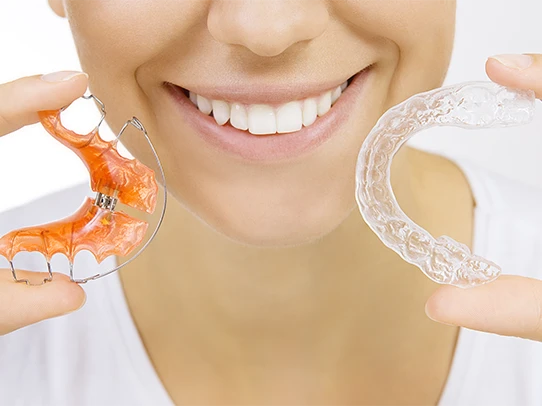
Wear your retainer every day for the first six months after your braces come off, then every night for the rest of your life. That is the schedule Dr. Timothy J. Bussick gives patients, and it is the simplest way to keep teeth straight.
That answer can sound like a lot at first, so here is why retainers matter, what the different types do, and how to make nightly wear an easy habit.
Why Do You Need a Retainer After Braces?
When braces or Invisalign treatment ends, the active phase of orthodontic care is complete, and a very important new phase begins. Your teeth have been moved into new positions, but the bone and tissue around them still need time to adapt. It can take at least four to six months for the new position of your teeth to become permanent.
During that time, and beyond it, teeth try to shift back toward where they started. Orthodontists call this relapse. On top of that, teeth naturally keep moving throughout life. A retainer is a custom-made device that holds each tooth where it belongs while all of that is happening. In short, retainers protect the investment you have made in your new smile.
How Long Should You Wear Your Retainer Each Day?
For the first six months after treatment, wear your retainer every day. Removable retainers come out for meals and for brushing, then go right back in. This is the period when teeth are most likely to shift, so consistency matters more now than at any other point.
After six months, most patients move to nighttime wear. From then on, you wear your retainer every night while you sleep, for life. There is no point where teeth stop wanting to move, so there is no point where retainer wear is truly finished. The good news is that once the habit is set, nightly wear takes almost no effort.
Your own schedule can differ based on your treatment, so always follow the specific instructions Dr. Bussick gives you at your debond appointment.
What Types of Retainers Are There?
Retainers come in removable and fixed styles, and Dr. Bussick recommends a combination of retainers to maintain straight teeth. Children who had early treatment may also wear appliances that hold progress between Phase I and Phase II.
| Retainer type | What it is | Removable? | When we use it |
|---|---|---|---|
| Hawley retainer | Thin metal wire with plastic or acrylic shaped to the roof of the mouth or inside the lower teeth | Yes | After braces or Invisalign |
| Invisible retainer (occlusal guard) | Clear removable tray that fits over the teeth | Yes | After treatment; also protects enamel from grinding and can act as a whitening tray |
| Bonded (permanent) retainer | Metal wire glued to the back of the teeth | No | Often combined with a removable retainer |
| Lingual holding arch | Appliance that holds space created during Phase I | No | Between Phase I and Phase II, until the 12-year molars erupt |
| Twin block | Appliance that advances and stabilizes the lower jaw | Yes | After Phase I braces come off, until Phase II |
Removable Hawley retainers are made of thin metal wire and plastic or acrylic, and they can be adjusted. Invisible retainers, also called occlusal guards, are clear and discreet. Besides holding teeth in place, they can double as whitening trays and protect enamel from grinding. A bonded retainer is a metal wire glued to the back of the teeth; it works wonderfully, which is why we often pair it with a removable option for extra security. You can see more about each style on our orthodontic retainers page.
Younger patients who complete Phase I treatment have a slightly different retention stage. A lingual holding arch maintains the space created during Phase I while the rest of the adult teeth erupt, and it is removed when the 12-year molars come in so Phase II can begin. A twin block appliance, delivered after Phase I braces are removed, encourages the lower jaw to grow forward and keeps it stable until the child is ready for the next phase.
Do You Need a Retainer After Invisalign Too?
Yes. Retainers are just as important after Invisalign clear aligners as they are after braces. The same biology applies: teeth moved by aligners need the same time to settle and are just as prone to relapse. When your final aligner is finished, wearing your retainers faithfully is what keeps your new smile in place.
What Happens If You Stop Wearing Your Retainer?
Teeth start moving back toward their original positions. Early on, that may show up as a retainer that feels tight when you put it back in. Over time, small gaps can reopen, or front teeth can begin to crowd again. Because the shifting tends to be gradual, many people do not notice it until the change is visible in the mirror.
If you miss a night here and there, put your retainer back in right away and get back on schedule. If it no longer fits or feels painful to wear, do not force it. Call the office so we can check the fit and protect your results.
What If Your Retainer Is Lost or Broken?
Call us at (260) 436-2255 as soon as you can. We will schedule an appointment to replace it and advise you of any repair or replacement fee at that time. The sooner you call, the less time your teeth spend without support. Patients can be seen at either our Southwest office on Engle Rd or our North office on Coldwater Rd.
The simplest way to avoid a lost retainer is to store a removable retainer in its case whenever it is out of your mouth.
How Do You Clean and Care for a Retainer?
A retainer you wear every night needs the same daily attention as your teeth. For clear removable retainers, the care routine is similar to what we recommend for Invisalign aligners: brush them gently with a soft toothbrush and lukewarm water every day. Avoid hot water, which can warp the plastic. A mild soap helps keep them fresh and free of bacteria.
Take removable retainers out before eating, and brush your teeth before putting them back in so food is not trapped against your teeth overnight. Let us know if a retainer cracks, bends, or starts to feel different.
Bonded retainers stay on your teeth, so the focus shifts to cleaning around them. Brush carefully along the wire and floss between the teeth it covers, and keep up your regular cleanings so your dentist can reach any spots that are hard to clean at home.
How Do You Make Retainer Wear a Habit?
Tie it to something you already do every night, like brushing your teeth before bed. Keep the case in the same spot every day.
Remember that your routine dental care continues too. Dr. Bussick recommends that all patients keep visiting their general dentist every four to six months, and a retainer is no substitute for brushing and flossing. For families with younger kids still in treatment, our page on orthodontics for kids explains how retention fits into Phase I and Phase II.
Frequently Asked Questions
Are you supposed to wear your retainer all day after braces?
Yes, for the first six months after your treatment ends. Remove removable retainers only to eat and to brush. After that, wear them every night.
Do I really need to wear a retainer forever?
To keep your teeth straight, yes. Teeth move throughout life, so Dr. Bussick recommends wearing your retainers every night for the rest of your life after the first six months.
Can my teeth shift if I skip my retainer?
Yes. Teeth try to return to their original positions, a process called relapse. The longer you go without your retainer, the more they can move.
Which retainer is best?
It depends on your treatment. Dr. Bussick recommends a combination of retainers and will fit you with the right options for your smile.
Have questions about your retainer or ready to start treatment? Schedule a free consultation at either Fort Wayne office.